
as your personal book + wine sommelier, I, along with my brilliant team, will be reviewing and recommending books + wine based on what we’re reading and drinking, in addition to sharing other thoughts about the book and wine industry. add your own comments to tell us what you’re enjoying reading and drinking! enjoy!

New Release Notes 4/5/22: Time Is A Mother by Ocean Vuong
Week of 04/05
Another week, another batch of the books we are most excited about here at Book + Bottle! From the most beautiful poetry, to Russian folklore, to national disasters we have something for every reader this week!
Time Is A Mother by Ocean Vuong
How else do we return to ourselves but to fold
The page so it points to the good part
You probably recognize Ocean Vuong’s name from his brilliant debut novel, On Earth We’re Briefly Gorgeous; a stunning discussion of masculinity, familial bonds, and the story of a man looking for his place in the world. In this collection of poems, Vuong looks at life after his mother’s death. Much like a master songwriter, Vuong’s lyrical and moving touch swirls and dances across the white space, and with every turn of the page you breathlessly ask for more.


New Release Notes 3/29/22: Two Storm Wood by Philip Gray
World War I is an often neglected war in the world of historical fiction, with many tomes being written about the Civil War and/or World War II. The Great War gets it’s due in this stunning book, a literary crime novel set on the front lines in the European theater of war as two people do what they can in their own ways to deal with the trauma of the experience as they hunt the perpetrator of ghastly war crimes. With a heroine that fans of The Alice Network by Kate Quinn would love and a narrative that is both dynamic and engaging, it’s a can’t miss!
Check back next week for more New + Noteworthy!


New Release Notes 3/29/22: Secret Identity by Alex Segura
Michael Chabon’s Kavalier & Clay + Patricia Highsmith’s Mister Ripley = this stunning new book. Segura’s time in the comic book industry paints the beginning of a struggling fictional comic book company in the 1970’s with grace and insight, and his love for hard-boiled crime fiction makes the book a delight to read, with twists and turns that make every page turn blindingly fast. When a new artist who’s doing her best to make it in the male-dominated world of comics finds a colleague dead, it’s a tantalizing whodunit, a tangled web of secrets and resentments among the passionate eccentrics who write comics for a living.


New Release Notes 3/29/22: Vagina Obscura: An Anatomical Voyage by Rachel E. Gross
Hello Book + Bottlers! We are starting a new weekly post featuring all of our favorite new (book) releases - sometimes we just can't contain our excitement to Instagram alone, and gotta tell you what is coming down the pike. Whether it’s nonfiction, short stories, the hottest hardcovers or palpitating paperbacks, we got you covered for all your reading needs!
Vagina Obscura: An Anatomical Voyage by Rachel E. Gross
The excitement around this book has been palpable. For fans of popular science writing, for those of you who liked ‘Bonk’ by Mary Roach or ‘Breasts’ by Florence Williams, this book takes you on a journey through seamless storytelling and insightful research about everything to do with the female reproductive system. At turns lyrical and hilarious and maddening, stories about biologists growing artificial ovaries to counter the cascading health effects of menopause and urologists remapping the clitoris to fill in crucial gaps in female sexual anatomy make up a calvacade of brilliant writing not only about the female body, but all bodies.


Book Review: With Teeth by Kristen Arnett
Kristen Arnett’s debut novel—Mostly Dead Things (Tin House, 2020)—situated her as a writer devoted to the weird. Her prose is highly specific, unabashedly chaotic, and a delight to read. Her latest novel, With Teeth (Riverhead Books, 2021), remains married to these qualities while painting readers a new picture: one of teetering love, mental instability, and the complexities bound up in queer marriage.
Our protagonist, Sammie Lucas, is unhinged. She and her wife, Monika, have a child, of which Sammie carried herself and is now the predominant caretaker. The reader watches as their lives post-child unfold—and they can’t look away, much like when you pass a fatal car crash on the highway. Sammie believes the catalyst of her dissatisfaction was the birth of their son, Samson.
But, one of the main questions this novel asks us to contemplate is whether or not children are reflections of ourselves. Throughout the story, we wonder: Is Samson a bad kid? Sammie certainly thinks so. In fact, she seems to harbor a level of disgust for her son. And, some of his actions are questionable. But Sammie is disgusted with herself, too. If we’re to believe that children are indeed reflections of ourselves, then we must decide whether Sammie’s disgust for Samson is more directed at herself. It’s worth noting that Sammie also has profound moments of love for her son, where she recognizes how similar they actually are.
Then, there’s Monika. She strives to make their lives seem progressive on the surface: two married women raising a son and defeating the odds. Yet this image quickly crumbles. While Sammie acts as Samson’s predominant caregiver, Monika assumes a more patriarchal role. She works all the time, is largely absent from Samson’s life, and doesn’t cook or clean. It’s a classic case of queer characters assimilating into heteronormativity. Sammie can’t stand it, but she also makes decisions (bad decisions) that keep her from ever solving this problem. Their marriage is on the brink, constantly, and they both fail to realize how this instability affects Samson throughout the story.
We see all of these themes from Sammie’s perspective. But the third-person limited narration sometimes dips into the perspective of secondary characters. This shows us a different side of Sammie. Slowly—through these secondary characters and Sammie’s own slip-ups—we learn that Sammie is woefully unreliable. Her perspective on life is obsessively skewed in a way that hinders her development from beginning to end. Therefore, the truths of queer marriage and motherhood are explored in a very untruthful way.
So, yes, Kristen Arnett has given us a novel predicated on chaos. And, she also happens to be based in Florida. With Teeth ensures that the oppressive Florida heat is present in all the right moments. It suffocates Sammie, encouraging the idea that she feels trapped in her life. And, it makes the reader sweat, too, much like the condensation that trails down Sammie’s ever-present beer cans.
This novel is written with a precise hand that evokes shock, disgust, doubt, and so many other emotions. Yet, Sammie’s story is disturbingly true. Outside of the weird, there is a loss of identity that stems from motherhood. It leads to so many of the events that take place in the novel. The sheer emotion of Sammie’s unhealthy habits will have you reeling until the very last page.
If you enjoyed this book, you’ll also enjoy:
Milk Fed by Melissa Broder
What Was She Thinking? [Notes on a Scandal] by Zoë Heller
Dept. of Speculation by Jenny Offill
Enjoy with:
A porch pounder: something light, easy, refreshing. It will cool you down from this book’s hectic heat.


Book Review: The Dangers of Smoking in Bed by Mariana Enriquez
‘Sometimes I think the crazies aren’t people, they’re not real. They’re incarnations of the city’s madness, like escape valves.’
Ghost stories aren’t about ghosts. Sometimes, they aren’t even about death. Ghost stories are usually mirrors, a reflection of who we are, and what we have become. During it’s time, Shirley Jackson’s Haunting of Hill House showed us true alienation and loneliness in a Cold War torn America. Toni Morrison’s Beloved showed us horror beyond comprehension, of state induced terror that perpetuates harm within the family unit. Time and again, ghost stories are what we tell ourselves to stay awake, because sometimes slumber is too deep, and we need to be woken up.
Mariana Enriquez’s ‘The Dangers of Smoking In Bed’ is an alarm bell, littered with errant witches, devious teenagers, hungry dogs, desperate ghosts, unflinching spirits, and women who crave…crave the disgusting, the necessary, the morbid. These twelve short stories bring us into the maelstrom of modern day Argentina, a country marred by political unrest and state condoned vanishings that have left an indelible scar on the nation. Argentina, it’s villages and cities and underpasses, become a moving entity within the stories, much like a ghost. It haunts and bends and doesn’t care necessarily about the people around it, it is blind to the pain of humanity’s suffering because it is the humans who brought it upon themselves.
The stories shock and they delight. Some are darkly comic, like the opening, ‘Angelita Unearthed’, others are sinister and take you to the deepest depths of the macabre, like ‘Meat’, and others take you to a place of fear that, for me, briefly resembles euphoria, like ‘Kids Who Come Back’. I say that, because stories are meant to make us feel something, aren’t they? And when I flipped to that final page, I looked over my shoulder out my patio glass door, and I expected someone to be there, watching me, waiting for me to look.
And that is what these stories do. They force you to look. At the garish, at the unseen of society. It makes you look at the repercussions of communities that don’t look, of people that don’t take the time to See, capitol S, what is happening to the people around them.
But, despite all this, there is also tenderness. There is caring. There is even love, in all this blood. And there is a lot of blood.
This is Enriquez's second collection, her first is our horror book club pick for October!

Buy from Book + Bottle Online: The Dangers of Smoking in Bed by Mariana Enriquez $27
If You Liked This, You’ll Enjoy:
Eat the Mouth That Feeds You by Carribean Fragoza
Milk Blood Heat by Dantiel W. Moniz
Vampires in the Lemon Grove by Karen Russel
To Be Drunk With:
Our Guggenheim Malbec Bubbles – if you are reading Argentinian Gothic, you need an Argentinian wine, and this fits the bill. Red berries from beginning to end.


Book Review: My Mother's House
Review by Dominic Howarth
I love me an unreliable narrator. Whether it’s the psychosis of Patrick Bateman in Bret Easton Ellis’ ‘American Psycho’ or the simple unreliability of our own perspectives and knowledge, showcased in Kazuo Ishiguro’s ‘Never Let Me Go’, nothing to me spells humanity like the foibles and lies of a narrator.
But what happens when the narrator isn’t a human at all, but a thing? And when that thing is a house?
In Francesca Momplaisir’s novel, My Mother’s House, one of three narrators is La Kay (Haitian for ‘the House), a structure that has seen it’s neighborhood in Queens develop over the years from an Italian enclave to a Haitian community of immigrants, trying to climb the American social ladder as they learn English, get jobs, and struggle through the new hardships that this country presents.
But La Kay sees all, and as we soon find out, not enough. Lucien and Marie-Ange, husband and wife who’ve fled Haiti in the 1980’s, raise their children inside the house, and open their doors to any immigrants need help, whether that’s with the language, with their paperwork, or finding work in the ever growing neighborhood of South Ozone Park.
Then, what leads to La Kay billowing flames and bursting pipes? What brings us to the screaming into the dark winter sky as it tears it’s own self asunder? Lucien cries from the outside, crippled from a stroke, that his girls are in there, for someone to save them.
And yet, his wife died years ago. His daughters have moved away. There is no one in there to save.
Except…
Momplaisir starts with a powder keg that has already exploded. Her intensity keeps your pulse pounding and her gritty narration makes you feel like you’re in a Martin Scorsese film. We peek into the life of Lucien, slowly unravel his vices and his evils, and wonder what was the cause for both and yet, Momplaisir never tells us the answers. Instead, she shows us a portrait of a man deranged, who understands that he ‘is nothing’ and yet will do whatever it takes to get exactly what he wants when he wants it, and maybe that is precisely why he does it. He exploits the people around him for his own superficial gain, his neighborhood on strings and himself a puppeteer, and the women around him are the ones who are the most destroyed by his actions.
The third narrator, Sol, is one of those women.
The story of her and her mother, and the entire immigrant experience is brutal, pulling no punches as Momplaisir examines how the trek into America can destroy those who make it, whether physically or mentally. Momplaisir pulls no punches as she investigates the female experience, and what some have to do in orde to live in ‘the land of the free’.
Some reviews of the book complain about no character development. While it is hard for me to argue with that, part of the appeal of the book is that these narrators are so close to the fires within, it’s hard for them to pull away, to breathe, and to change…much like in real life. The evil that surrounds them, that is inside of them, engulfs like the flames of the house, and the book doesn’t let us look at what comes after a fire. We’re in the fire the entire time, if not literally, then thematically. And sometimes, so is life.
If You Enjoyed This Book, You’ll Also Enjoy:
The Water Dancer by Ta-Nehisi Coates
Americanah by Chimamanda Ngozi Adichie
Beloved by Toni Morrison
Enjoy with: A deep pinot noir, with heavy tannins that make you thirsty for more.

Sister Power: July 2021 Book + Bottle Pairing
A few months ago, I received an email promoting a new book coming out this summer. I receive about a hundred of these a week, so most of these don’t grab my attention or even garner a second look as I try to plow through my emails. But this one in particular caught my eye. The author’s name…it sounded so familiar.
As memories started bubbling up to the surface, I did a bit of googling and facebooking, and sure enough. Melissa Scholes Young is the wife of one of my college professors who sat on my thesis committee. She was doing her PhD at the time, and now here she is, a professor of literature at American University in DC and the author of this great new book. I had to reach out to say hi and let her know that I was going to promote the heck out of her book.

THE BOOK
The second I read the premise of the novel, I knew it would be a great story for the summertime and would be making an appearance in our Readers + Drinkers Club. Set in rural Missouri, four sisters grow to depend on each other as young adults as their family’s pest control business changes hands and the life they once knew begins to unravel. I read the first scene of the book just as the summertime heat was rolling into town - the girls in the story are playing and fishing in the Mississippi river where their family used to vacation. It’s not all fun and games though. I love this book because not only does the family drama reel you in and keep you urgently flipping the pages, but there’s substance, too - cultural, economic, and political, reflecting the big changes our country went through back in 2009 when the book is set, without ever becoming overwhelming or unnecessary. The novel is just what you want for the summertime: light, easy-reading, entertaining, and cinematic. It’s perfect for the beach, a cabin vacation, or your couch on a rainy afternoon. If you enjoyed Where the Crawdads Sing or are into Little Women, this is the novel for you.

THE WINE
To pair with this story, we mainly needed something chill-able (it is summertime, after all). More than anything, the sisterhood theme of the story stood out to me, and I recalled a yummy wine we had months ago that was made by sisters, but the whole story is even more of a perfect match than I had realized. Suavia is a northern Italian winery that began in 1982 with a young couple who started crushing their own grapes to make wine. They have since turned the family business over to their four daughters, three of whom run the winery today.
The winery Suavia is named after the medieval name for the city of Soave, where the famous wine Soave comes from. Like many European or Old World wines, Soave is called after the place rather than the grape. The grapes used to make this white wine are the green grapes Garganega and Trebbiano di Soave, native, indigenous grapes to this mountainous northern region of Italy.
Additionally, the aromas and flavors of this wine create a perfect pairing for the story found in The Hive. Delicate and easy drinking, the wine has notes of sweet flowers, like honeysuckle and jasmine, crisp fruit like fresh apples, and a pleasant, smooth minerality. But what you’ll also notice is a gentle hint of honey, just like the honey from the hive that the Fehler sisters build in the novel.
I’m especially excited to announce that author Melissa Scholes Young is going to do a virtual author happy hour with us to talk with us about her book - a Readers + Drinkers Club exclusive. Sign up here to register for her virtual event on 21 July 2021 at 7PM. Talk to you then! Cheers!

(Cook) Book Review: Pie Camp
Review by Elizabeth Fajardo
Summer break always makes me want to learn something.
I have always been a bit of a contrarian, especially when it comes to school work. I never wanted to do homework during the school year, but some how, the second final exams are over, I have the urge to learn new things, hobbies, information, or otherwise. I probably like learning over summer break the most because it is a time when I am able to construct my own lesson plan, and because as an adult, I no longer have summer camps to occupy my time, what else have I to do if not learn? Well this summer we are doing both; we are going to Pie Camp!
Every time I tell people that I love making pie, I get weird looks. From many seasons of great British bakeoff, I have learned that pastry crust is the bane of many home baker’s existence. Temperature control, shrinking, and worst of all repeated rests in the refrigerator, all make pie crust difficult to work with. I argue that is because of lack of knowledge.
Baking, I have found, has a rather high barrier to entry (can you see that economics degree coming in handy?). It’s hard to bake something well the first time if you don’t bake all that much, which can get very discouraging very quickly. I, myself, (and many other chefs who are much better than me: Claire Saffitz, Melissa Weller, and Magnus Nielson to name a few) argue that this is not due to baking being anymore difficult than cooking, its preferred sister discipline. But rather, baking is more difficult because we as home cooks do it less, and with less practice comes less intuition and more frustration. Pie Camp by Kate McDermott changes all that.
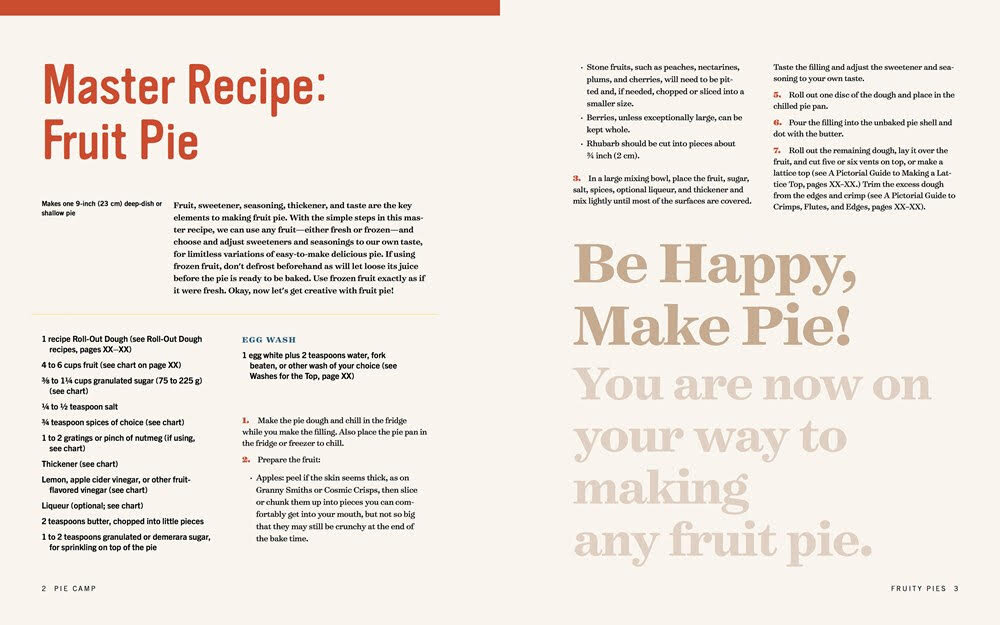
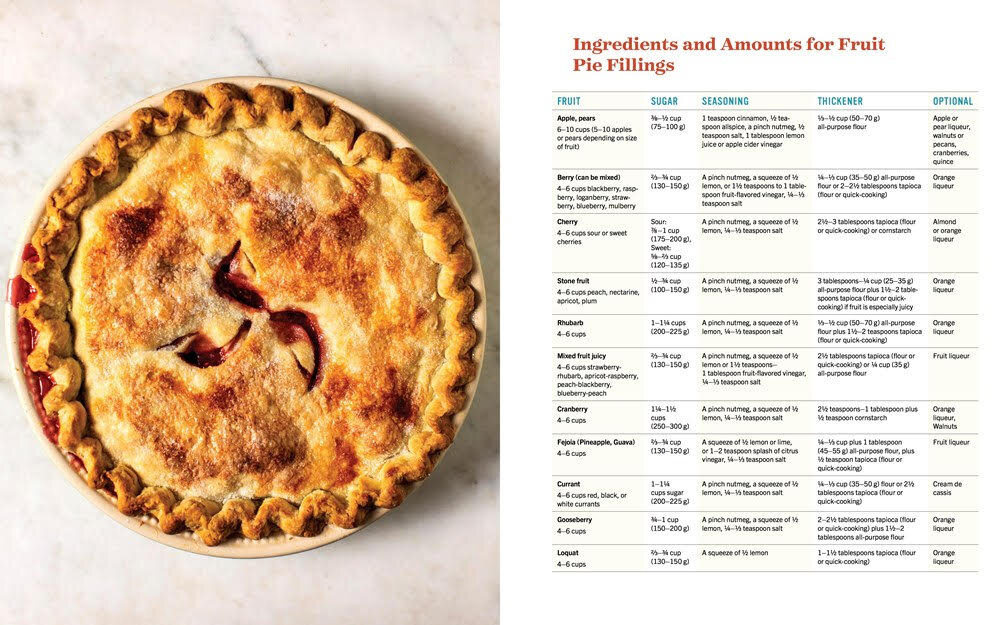
What started as an actual camp and then became a book, Pie Camp is less of a series of recipes for many different baked goods and more a handful of master recipes which McDermott riffs on throughout the book. Tables, golden rations, charts, diagrams are all used to show you how to get from basic pantry staples to enviable pies, turnovers, crisps, and crumbles with as little frustration as possible.
I’m going to be honest. I have only made one pie from this book. After absconding with it at B+B and reading it cover to cover like a novel, I quickly threw together the Apple Blackberry pie which, if I do say so myself, was pretty good. But the crust recipe that I used was my tried and true from A Baker’s Year with McDermott’s method, and I only half read the recipe. I would argue, that is the point of this book. This is a book you read to perfect your pies, to learn how to easily throw together a pie. I have used the charts more than I have followed the recipes, and my pie game has certainly elevated.
I love making pie crust. After having eaten one of my pies, Adaze, the newest member of our B+B Clique, asked me how I make my millimeters thin pie crust (the most difficult and misunderstood part of a good pie), I then went on to tell her an extensive 10+ step process, Pie Camp’s extensive 10+ step process. I think I have turned her off pies for the rest of her life. My and her time would probably been better spent if I had just handed her McDermott’s book. Certainly, rather than being discouraged she would have been excited to get home and make pie.
The reason kids go to camp is to have fun. Don’t get me wrong, it is also important to give parents a brief respite within which to clean their house and have a glass of wine. But the reason kids want to go to camp is to have fun. This book makes pie fun, something I think most home bakers don’t believe it to be. It takes the guesswork, mistakes, confusion, and eventual frustration out of pies, and in return, it gives you a pie. How great is that? So, with the Fourth of July just around the corner, what better time is there to perfect your apple pie?
“Pie camp is the only camp I’d wanna visit.” - Dominic, Book Club Maestro and all around great guy


Book Review: Tender is the Flesh
Review by Dominic Howarth
I’m an omnivore at heart. I was raised on chicken parmesan, fish sticks, crunchy broccoli, hearty heads of romaine lettuce. I would eat anything. I had a voracious appetite.
I was also raised on horror. First, it was Goosebumps by R.L. Stine. Then I graduated to the harder stuff, like Clive Barker. I bobbed and weaved with different American authors, mostly male. Mostly white. I felt like I was reading the same stuff, over and over, and over again. I moved away from the genre entirely, focused on magical realism and nonfiction for a while.
Then, South America brought me back.
Tender is the Flesh by Agustina Bazterrica (translated by Sarah Moses) takes us into the heart of darkness and asks us which valve we would want on our plate. Hailing from Argentina, Agustina brings us into a world where a terrible disease has tainted all animal meat, removing it from the food chain. In place of that, humanity has decided to keep producing meat all the same, with people instead of cattle. Note, they now call it ‘special meat’, not ‘human meat’. They are not ‘people’, they are ‘the head’. They are not the first humans to be caged and sold and bred, they are ‘F.G.P’, or, ‘First Generation Pure’.
And Marcos is very good at what he does. He deals with ‘the head’, making sure the ‘special meat’ truly is pure, that the processes in place or done in as swift a manner as possible. In this cold and lifeless environment, we are slammed into the stainless steel whisper of the environment by Agustina’s taciturn and procedural prose. We see Marcos go about his day, and we are introduced to horror after horror, that for the sake of this blog I will not go into and will save for when you pick up the book yourself. Agustina knows when to turn away and when to push us into the blade of the buzzsaw. It’s visceral, and it stains.
If you want intense world-building, you won’t find it here. She doesn’t get us bogged down in too many of the hows and whys, just enough to understand that people will do what they need to do to get what they want, no matter how terrible it may be.
While originally written as a case against the general meat industry (and a scorching one at that), I can’t help but think about how this book holds up in a post-pandemic world. If I had read this book in 2019, I would have probably enjoyed it, but I would have looked at the idea of a world that could so quickly turn it’s back on so many people, for such an insane notion of bacon in the morning, and scoff. But, eventually, America will have to come to grips with how (at the time of this writing) we allowed 600k Americans to die, and we will have to come to terms with that. How, in our own way, we gave up a social good for an individualized need. Because we needed bacon in the morning.
I’m still an omnivore at heart. I eat a little more veggies now.
If You Liked This I Would Recommend:
‘Things We Lost In The Fire’ by Mariana Enríquez
‘Hurricane Season’ by Fernanda Melchor
‘Little Eyes’ by Samantha Schweblin
Best Enjoyed With: Something light!
Best Enjoyed When: You are nowhere near raw meat.
THE BOOK:
Tender is the Flesh, Agustina Bazterrica, Sarah Moses (Translated by), $16


Book Review: Take More Vacations: How to Search Better, Book Cheaper, and Travel the World by Scott Keyes
Review By Kindall Edwards
I think it's safe to say that many of us are itching for our next vacation after the events of this last year. I find myself daydreaming of my next big adventure - biking through Amsterdam, that first bite of cacio e pepe in Rome, even just the sheer excitement and anticipation of boarding a flight. But then the reality sets in - the cost of these types of trips can be pretty overwhelming and sometimes feel entirely unattainable. With this recent release from Scott Keyes, Take More Vacations sets out to break your preconceived notions about such adventures. He attempts to reframe your psychology about vacations and travel planning with the intention you experience the best trips at the best prices. And while many international destinations are still not feasible, I found myself taking notes and getting inspired to start planning for when the day comes.
You might recognize the name Scott Keyes, founder of Scott's Cheap Flights, a travel platform that tracks and alerts you of the best flight prices. And while this book may come off as a shameless plug for his subscription, there's a reason Keyes has over two million members around the world that have saved over five-hundred million dollars on airfare since 2015. But his philosophy isn't solely fixated on scoring deals; in Take More Vacations, he's hoping to change your overall experience on how you plan your travels.

While you may assume this book to be a how-to on the detailed strategy of booking cheap flights, and while you're not exactly wrong, as there are many good takeaways about the dos and don'ts of booking flights. However, it focuses more on keeping an open mind and embracing serendipity when planning a trip. Keyes compares different flight booking methods that center around travelers varying priorities and how that distinction can drastically reflect the price of your plane tickets. By deviating away from destination-centric booking to a more opportunistic perspective of letting low prices determine your travel plans, you're opening yourself to more than just a great deal.
By surrendering to fate and frugality, the satisfaction extends beyond the cheap flight ticket. You're able to fully enjoy your vacation knowing you scored the best price by not having an insanely priced ticket expense looming over you. And consequently, more money in your pocket to spend on activities, better hotels, or even another vacation than if you had settled on a highly overpriced flight. The idea of possibly visiting a place I had never considered before was one of my favorite takeaways from Take More Vacations. By letting the price of tickets inform my destination, I could experience the pleasant surprise of seeing someplace off of the usual bucket list of travel goals.
Even if big travel plans aren't in the picture right now, this book is great for any traveler looking for a bit of inspiration and tips along the way. Whether you want to learn which airports are cheapest to fly out of or whether to use cash or miles for a flight, Take More Vacations has your answer. Contrarily, if you're a person just searching for deals, you might want to invest in a Scott's Cheap Flights subscription simply. Overall, Take More Vacations is an excellent guide to understanding the travel system and enjoying planning your next vacation.
The book:
Take More Vacations : How to Search Better, Book Cheaper, and Travel the World
by Scott Keyes
$16.99